


Treatment-resistant depression affects millions of adults who do not respond adequately to standard antidepressants. Ketamine-based treatments—specifically the FDA-approved esketamine nasal spray (Spravato) and off-label intravenous (IV) racemic ketamine—offer a rapid-acting alternative that can reduce symptoms within hours to days rather than weeks.
Clinics and outpatient facilities increasingly want to offer or coordinate these therapies. However, they often lack consistent access to psychiatric expertise for patient selection, treatment planning, medication management, and follow-up. FasPsych’s telepsychiatry staffing fills this gap by connecting organizations with board-certified psychiatrists and psychiatric nurse practitioners who can perform evaluations, make prescription recommendations, and e-prescribe via secure telemedicine.
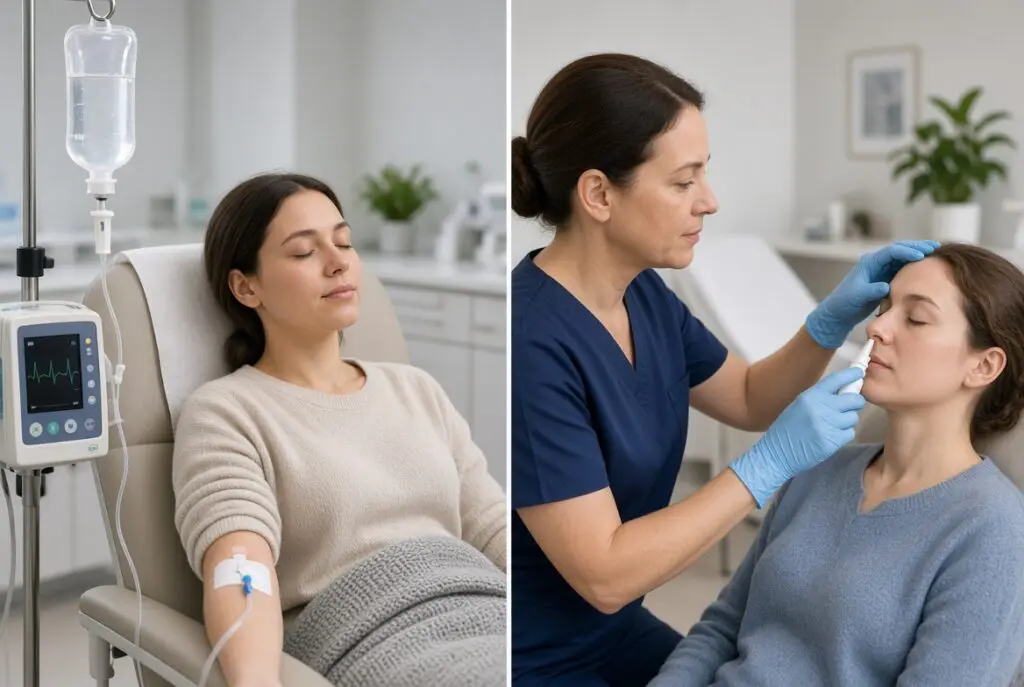
FDA Approvals: Esketamine Nasal Spray vs. IV Ketamine
Esketamine nasal spray (Spravato) is FDA-approved for:
- Treatment-resistant depression (TRD) in adults (initially approved 2019 as adjunctive therapy; monotherapy approved January 2025)
- Depressive symptoms in adults with major depressive disorder (MDD) and acute suicidal ideation or behavior (adjunctive, approved 2020)
Spravato is available only through the FDA-mandated Spravato REMS program because of risks of sedation, dissociation, and respiratory depression. Every dose requires supervised administration in a certified healthcare setting followed by at least two hours of monitoring.
IV racemic ketamine is FDA-approved only as a general anesthetic. Its use for depression is off-label. While supported by clinical research, it lacks a formal psychiatric indication and the structured REMS framework of Spravato.
These regulatory differences influence insurance coverage, administration logistics, monitoring requirements, and documentation.
How Ketamine and Esketamine Work Differently from Traditional Antidepressants
Conventional antidepressants primarily affect serotonin, norepinephrine, or dopamine. Ketamine and esketamine are NMDA receptor antagonists that increase glutamate signaling. This appears to promote synaptic plasticity through pathways involving AMPA receptors, BDNF, and mTOR, supporting the formation of new neural connections disrupted by chronic stress or depression.
Clinical trials and real-world data show many patients experience meaningful improvement within hours to one day. The 2017 American Psychiatric Association consensus statement on ketamine for mood disorders helped establish cautious, evidence-informed clinical practice while highlighting the need for additional long-term safety data.
IV Ketamine vs. Esketamine Nasal Spray: Key Differences
| Feature | IV Racemic Ketamine | Esketamine Nasal Spray (Spravato) |
|---|---|---|
| FDA Status | Off-label for depression (approved as anesthetic) | FDA-approved for TRD (including monotherapy) and MDD with acute suicidal ideation or behavior |
| Administration | IV infusion (~0.5 mg/kg over 40 minutes) | Patient self-administers under direct observation |
| Typical Induction | Often 6 sessions over 2–3 weeks | Twice weekly for 4 weeks, then weekly, then every 1–2 weeks |
| Monitoring | Clinic protocols vary | REMS-required ≥2 hours with pulse oximetry; no driving until next day |
| Insurance | Often limited or cash-pay | Frequently covered with prior authorization |
| Setting | Specialized infusion clinics | REMS-certified outpatient settings |
Neither treatment is first-line for most patients. They are generally considered after inadequate response to at least two adequate antidepressant trials.
Evidence, Outcomes, and Realistic Expectations
Phase 3 trials supporting Spravato’s FDA approval, along with multiple randomized studies of IV ketamine, demonstrate rapid reductions in depressive symptoms versus placebo or active controls. Details appear in the official Spravato prescribing information. Some studies have also shown IV ketamine to be non-inferior to electroconvulsive therapy in non-psychotic treatment-resistant depression.
Response rates vary. Some patients achieve remission; others see partial or short-lived benefit. Maintenance treatment is usually required because effects from a single course often last days to a few weeks. Direct head-to-head randomized trials comparing IV ketamine and Spravato remain limited.
Safety, Monitoring, and Clinical Workflow
Common effects include dissociation, sedation, temporary blood pressure elevation, and nausea. Long-term or frequent use may carry risks of urinary or bladder issues. Spravato’s REMS program mandates certified settings, patient enrollment, supervised dosing, and documented monitoring. IV ketamine protocols similarly require in-clinic observation.
Contraindications include uncontrolled hypertension, certain cardiovascular or cerebrovascular conditions, history of psychosis, active substance use disorder involving dissociative agents, and pregnancy. Thorough evaluation is essential before treatment.
FasPsych virtual mental health evaluations and adult psychiatric services support screening, treatment planning, and ongoing medication management—including prescription recommendations and e-prescribing for concurrent oral antidepressants or other psychiatric medications.

How FasPsych Telepsychiatry Supports Ketamine Care in Clinics and Outpatient Facilities
Administration of IV ketamine or Spravato must occur in a supervised clinical setting. Psychiatric expertise is still required for:
- Diagnostic evaluation and treatment-resistant case review
- Coordination with on-site infusion or Spravato teams
- Medication optimization and e-prescribing
- Monitoring response, side effects, and relapse
- Integration support and between-session follow-up
- Urgent or on-demand coverage
FasPsych connects clinics and outpatient facilities with licensed psychiatrists and psychiatric nurse practitioners through secure, HIPAA-compliant telemedicine. Providers can complete evaluations, issue prescription recommendations, and e-prescribe medications as clinically appropriate. Organizations access the nationwide provider network with flexible models, including on-demand psychiatry and hybrid telemedicine.
This approach expands capacity without the cost and complexity of full in-house hiring, supports continuity for patients traveling to treatment sites, and integrates with existing EHR workflows. Facilities pay only for clinical time used.
Frequently Asked Questions
What is the difference between Spravato and IV ketamine?
Spravato is the FDA-approved esketamine nasal spray indicated for treatment-resistant depression and MDD with acute suicidal ideation or behavior. IV ketamine is racemic ketamine used off-label for depression. Spravato has a formal REMS program and is often better covered by insurance; IV ketamine protocols vary by clinic.
Is Spravato FDA-approved as monotherapy?
Yes. In January 2025 the FDA approved Spravato as monotherapy for adults with treatment-resistant depression who have not responded adequately to at least two oral antidepressants.
Can telepsychiatry providers prescribe medications for patients receiving ketamine or Spravato?
Yes. FasPsych psychiatrists and psychiatric nurse practitioners can perform evaluations via telemedicine, make prescription recommendations, and e-prescribe medications for clinics and outpatient facilities, including concurrent psychiatric medications.
Who is a candidate for ketamine or esketamine treatment?
Typically adults with treatment-resistant depression who have not responded to at least two adequate antidepressant trials. Careful medical and psychiatric screening is required. These treatments are not appropriate for everyone and are not first-line for most patients.
Does FasPsych administer IV ketamine or Spravato?
No. FasPsych provides telepsychiatry staffing for evaluations, treatment planning, medication management, and coordination. Actual administration of IV ketamine or Spravato must occur in an appropriately equipped and certified clinical setting.
How quickly do patients typically respond?
Many patients notice improvement in depressive symptoms within hours to one day. Duration of benefit varies, and maintenance treatment is often needed.
What monitoring is required after Spravato?
Under the Spravato REMS, patients must be monitored on-site for at least two hours after every dose for sedation, dissociation, respiratory depression, and vital sign changes. Patients cannot drive until the following day after a restful sleep.
Partner with FasPsych for Scalable Psychiatric Support
Clinics and outpatient facilities seeking to expand access to advanced treatments such as FDA-approved esketamine nasal spray or coordinate care around off-label IV ketamine benefit from reliable telepsychiatry expertise. FasPsych has partnered with organizations nationwide since 2007 to deliver flexible, high-quality psychiatric staffing—including evaluations, prescription recommendations, and e-prescribing via telemedicine.
Partner with FasPsych to discuss how telepsychiatry can support your ketamine or esketamine care pathway and overall behavioral health capacity.
This content is for informational purposes only and does not constitute medical advice. All treatment decisions must be made by qualified clinicians based on individual patient assessment. Refer to the official Spravato prescribing information and REMS program for current FDA-approved indications, dosing, and safety requirements.